Planning Permission for Awnings in the UK: What Homeowners Should Know
An awning is one of those upgrades that looks straightforward: fix it to the wall, roll it out when the sun appears, and enjoy your patio.
Planning-wise, though, anything that changes the outside of a home can fall into the “development” bucket – and whether you need permission depends on where it sits, what it looks like, and what it effectively creates (a modest shade cover, or something more like a permanent veranda).
The good news is that many domestic awnings can be installed without a full planning application, as long as you stay within the usual limits and conditions.
First, be clear what kind of “awning” you’re actually installing
Homeowners use the word “awning” for a few different things, and the planning route can change depending on which one you mean.
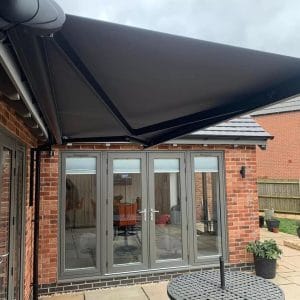
A retractable, fabric cassette fixed to the rear wall is usually treated very differently from a fixed canopy with posts, side panels, lighting, and a big “outdoor room” feel.
The Planning Portal notes that a freestanding awning (or gazebo-style cover) will often be treated like an outbuilding for permitted development purposes, which brings its own placement and height expectations.
Planning permission vs permitted development: the key idea to understand
In much of the United Kingdom, many everyday home improvements are allowed under “permitted development rights” – a general permission set by the government, so you don’t need to submit a full planning application each time.
The catch is that permitted development is not a blank cheque: it comes with limits (what you can build), conditions (how it must look), and exclusions (where the rights don’t apply, or have been removed).
In practice, an awning often sits in the “likely permitted, unless…” category – so the smart move is to identify the “unless” triggers early, before you order a made-to-measure unit.
If it’s freestanding, it’s often treated like an outbuilding
If your shading is not attached to the house – for example, a freestanding awning or gazebo-style structure – it’s commonly considered an outbuilding in planning terms.
The Planning Portal guidance says that a garden gazebo or freestanding awning will often fall under permitted development, but it should not be in front of the house and should not be more than 2.5 metres in height (in that typical outbuilding context).
This is why “that little shade cover in the front garden” can be more problematic than a similar one tucked behind the house.
If it’s attached to the house, the “front of house” rule is the big tripwire
For attached awnings, one of the most common reasons people get caught is location – especially anything on the front elevation, or on a side elevation that faces the street.
Government technical guidance on householder permitted development explains that development is not permitted if it would extend beyond a wall forming the principal elevation, or beyond a side wall that fronts a highway – meaning work in those positions typically needs planning permission.
In real life, that often means: a neat awning above a front bay window or above a front door can be more likely to require consent than the same awning installed at the rear.
Beware the “veranda” problem: some awnings become more than an awning
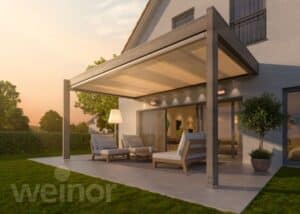
Another major trigger is when an awning effectively creates a veranda-like structure. Under the same technical guidance, verandas, balconies, and raised platforms are not permitted development and require planning permission.
The guidance even defines a veranda as a roofed (often partly enclosed) gallery or platform along the outside of a building at ground level.
A basic retractable awning with no platform is usually not a “veranda” in the everyday sense – but if your design includes posts, side enclosures, substantial framing, or it starts to read as a permanent covered outdoor structure, you move closer to the “permission likely” zone.
Designated areas and removed rights: why your neighbour can do it but you can’t
Even if an awning would normally be fine under permitted development, your property may sit in an area where the rules tighten.
The England guidance highlights that permitted development rights can be more restricted in designated areas such as conservation areas, national parks, Areas of Outstanding Natural Beauty, World Heritage Sites, and the Broads.
On top of that, local councils can remove permitted development rights via an Article 4 Direction, or a planning condition attached to a past permission – so it’s possible for the “standard answer” online to be wrong for your street.
Flats, maisonettes, and leasehold homes: planning is only part of the picture
Most of the well-known householder permitted development rules are aimed at houses, not flats and maisonettes.
The Planning Portal notes that permitted development rights applying to many common house projects do not apply in the same way to flats or maisonettes. If you’re leasehold (even in a house), you may also need separate permission from a freeholder or management company, because fixing an awning to external walls can count as altering the building fabric under your lease.
Planning approval doesn’t override private legal restrictions, so it’s worth checking both early.
Listed buildings: assume you’ll need consent for anything fixed to the exterior
If your home is listed, treat any external attachment- including awnings, canopies, signage, lighting, and brackets – as something that may require formal consent.
Many councils state plainly that works which attach to or abut a listed building will require Listed Building Consent. The rationale is straightforward: even “small” changes can affect character and historic fabric.
In practice, the design (materials, fixings, visibility, and reversibility) matters a lot, and a heritage or conservation officer may want to see details before anything is installed.
If your awning includes branding, you may be in “advertisement consent” territory
Homeowners usually aren’t putting logos on awnings – but it’s common on shopfront-style canopies, home salons, or short-term lets.
If an awning displays an advert or sign, you may need advertisement consent, which is a separate approval process under the Town and Country Planning (Control of Advertisements) Regulations.
The Planning Portal points out that you may need advertisement consent for signs above a certain size (and for illuminated signs regardless of size). So, for anything more “commercial-looking”, check signage rules as well as awning rules.
The cleanest way to avoid doubt: ask the council, or get an LDC
If you want certainty before spending money, you have two sensible options.
The informal route is a quick check with your local planning authority – especially if you’re near the front of the house, in a conservation area, or unsure whether your design could be seen as a veranda.
The formal route is applying for a Lawful Development Certificate (LDC), which confirms your proposal is lawful for planning purposes (or confirms an existing situation is lawful). The Planning Portal explains that an LDC isn’t compulsory, but it can provide peace of mind – and can be helpful when selling your home.
What to prepare if you do need permission
If your awning triggers a planning application, it’s usually handled under a householder planning route. You’ll typically need a location plan, drawings showing the awning’s position and projection, dimensions, materials/colour, and notes on visibility from the street and neighbour impact.
If the issue is “front elevation” or “street scene”, good visuals matter – a simple elevation drawing and a photo montage can reduce back-and-forth.
If the concern is whether it becomes a veranda, be clear about what you are not building (no platform, no enclosure, minimal supports), because that distinction can be decisive.
Don’t forget the practical compliance bits: structure and electrics still matter
Planning permission is only one layer of “doing it properly”. Awnings need secure fixings into appropriate substrate (brick type, lintels, insulation build-ups), and they must be rated for wind loads – especially larger projections.
If you’re installing a motorised awning that involves wiring into the mains, electrical work should comply with the relevant safety requirements under Approved Document P (Part P) for dwellings in England.
Even if planning permission isn’t needed, a safe installation (and the right paperwork where applicable) is what protects you long-term.
A simple rule of thumb to finish on
Most homeowners are fine when the awning is modest, positioned at the rear, and doesn’t create a permanent veranda-like structure. The risk rises quickly when it’s on the principal elevation, visible from the street, in a restricted area, attached to a listed building, or carries signage.
When you’re anywhere near those edges, a quick council check – or an LDC if you want certainty – is usually cheaper than arguing after installation.
Should you require any additional information about our awning ranges and awning accessories, please don’t hesitate to contact the team. At Fraser James Blinds, we are professional, friendly and always happy to help. Alternatively, you can also arrange a home visit.